I was interviewed for the Paul Hudson Weather Show for Radio York the other day - i had to go to the BBC radio studios in Blackburn and did the interview over the phone. There are a few days left to listen to the programme online:
http://www.bbc.co.uk/programmes/p01997bn#programme-broadcasts
Me and Ann Dinsdale, the Collections Manager of the Bronte Parsonage Museum, are on 40 minutes into the show. I talk about the Bronte Weather Project and the artwork I made during my residency.
It's been a bit difficult listening to my own voice - in my head i sound like the queen.
It was often raining when I woke during the night, a light capricious shower, dancing playful rain, or hushed, muted, growing louder, more persistent, more powerful, an inexorable sound. But always music, a music I had never heard before.
Wide Sargasso Sea by Jean Rhys
I've just returned from 3 weeks working in Romania on a residency - a wonderful and amazing place. And while there I read Wide Sargasso Sea by Jean Rhys - the story of the first Mrs Rochester in Charlotte Bronte's Jane Eyre.
I loved the book and had always wanted to read it during the weather project, but haven't had time until now. I bought my copy on the flea market in Preston.
I am delighted to say that the set of three colour wheels I made for the Hope's Whisper exhibition have been purchased by the Bronte Parsonage Museum for their permanent collection.
The colour wheels show the many types of weather that each of the Bronte sisters mention in their writing. I chose to analyse one novel for each sister : Emily Bronte's Wuthering Heights; Anne Bronte's Tenant of Wildfell Hall; and Charlotte Bronte's Jane Eyre.
Visualising the data in this way reveals the diversity of the weather types that they reference. From mist and rain to sunshine and gales they use weather types that I put in to 18 different categories.
It's interesting that Anne Bronte mentions sun / sunshine more times in the Tenant of Wildfell Hall than any other weather type at 17.4% of the total weather references within the novel and although Emily Bronte mentions wind most times in Wuthering Heights at 20% of all references in the novel the second highest category is sun / sunshine at 14.8%. Looking at the data this way reveals how they mention far more 'fine' weather types than is commonly presented through films, TV dramas and book cover illustrations: the popular perception being a rain soaked, wind swept Bronte landscape.
The Brontes' work has influenced so many people in so many ways and it's incredible to think they probably never knew how inspirational their literature would become.
With this in mind i thought i'd share with you some of the influence they have had on ye olde local Haworth economy.
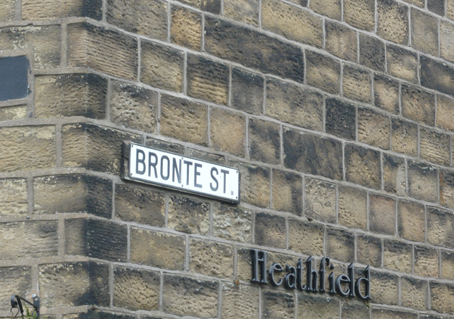
Walking around Bronteland reveals one of their legacies - the naming of totally unrelated places/things to capitalise on the Bronte pound.
I have two favourites: Eyres 'N' Graces (see what they've done there?)
And best of all: Bronte Balti - fabulous!
The Bronte Weather Project has officially finished now, however there are still a couple of loose threads to tie up, so i had to go over to the Bronte Parsonage Museum yesterday. I was meant to go on Tuesday, but because of the snowy freezing weather it got delayed a couple of days.
The trip over the moors was really spectacular - the snow covering everything and the colour of the sky mingling in with the hills. Thankfully the roads were clear, so the bus journey was not too fraught.
The Museum is closed to the public at the moment as they spend time redecorating the whole house. It was interesting to be in the Museum in a state of change - and the work carried out so far is absolutely beautiful - gorgeous paints and wall papers that have been especially chosen and researched to fit in with how the Bronte family would have had it. It's going to look stunning when it's finished.
It was the opening last night of Wildness Between Lines at Leeds College of Art.
I have one of my graph drawings in the show, along with the complete weather archive and a few of my books. The weather station has also been set up in the gallery.
Lots of people braved the freezing cold weather to enjoy a glass of wine and collect a lovely little exhibition catalogue - and i saw a few people i know.
It is a group show and each of us have used the Bronte sisters in some way to influence the making of artwork. Artists in the show are: Catherine Bertola, Su Blackwell, Bristow & Lloyd, Victoria Brookland, Paula Chambers, The Hellars, Victoria Lucas, Lisa Sheppy, Aymee Smith, Stephanie Vegh, Simon Warner, Marci Washington, Teresa Whitfield, David Wilson and me.
There are some really beautiful works in the exhibition, so try and get along if you get the chance. Details of opening times are below.
One of my Bronte graph drawings, the completed weather archive and my collection of tabbed Bronte books are going to be on show in Leeds from this Friday.
Wildness Between Lines is at Leeds College of Art (on Blenheim Walk) and runs from 14th December until 2nd February 2013.
It is open Monday - Friday 10am - 4pm and entry is free.
It's the preview on Thursday night 5 - 7pm - if you fancy coming along?
The lovely weather station from my residency at the Bronte Parsonage Museum will also be on show in the gallery - it'll be good to see that inside as a remembrance of the project.
The images above are of my Bronte books, tabbed where every reference to the weather is found: Wuthering Heights, Jane Eyre, The Professor, Agnes Grey, Tenant of Wildfell Hall, Shirley and Selected Poems.
http://www.leeds-artexhibitions.co.uk/

"This is an autumn evening, wet and wild. There is only one cloud in the sky, but it curtains it from pole to pole. The wind cannot rest; it hurries sobbing over hills of sullen outline, colourless with twilight arid mist. Rain has beat all day on that church tower. It rises dark from the stony enclosure of its graveyard. The nettles, the long grass, and the tombs all drip with wet. This evening reminds me too forcibly of another evening some years ago - a howling, rainy autumn evening too - when certain who had that day performed a pilgrimage to a grave new-made in a heretic cemetery sat near a wood fire on the hearth of a foreign dwelling. They were merry and social, but they each knew that a gap, never to be filled, had been made in their circle. They knew they had lost something whose absence could never be quite atoned for so long as they lived; and they knew that the heavy falling rain was soaking into the wet earth which covered their lost darling, and that the sad, sighing gale was mourning above her buried head. The fire warmed them; life and friendship yet blessed them; but Jessie lay cold, coffined, solitary - only the sod screening her from the storm."
Shirley by Charlotte Bronte written in 1848 / 49
I finished it! All 627 pages of it. I admit there are some nice passages in the book, however i found it a really hard slog - like trying to get up a featureless hill on your knees in the rain. Sorry.
This does mark the end of reading Bronte texts for the project though - that's all i've read more or less for a year - so i am in a dither as to what to read next...
When i was last at the Bronte Parsonage Museum i collected all the completed cards that the weather collectors have filled in.
They have been writing weather records every day for more than a year from October 18th 2011 until November 5th 2012. Everyone who volunteered lives in the local area around Haworth.
I always presumed we might get a couple of days in the year when nobody collected any information at all maybe when on holiday, perhaps from illness, or being busy might mean that nobody managed to write anything down on some random dates. However, I have records for every single day during that time. I originally started with 10 collectors, but towards the end of the year it was down to four dedicated individuals who were still collecting notes every day. Amazing.
So, i spent the last couple of days cutting out the divide cards, stamping them and then sorting all the hand written cards into date order.
I'm thrilled that it's finished and the entire archive will be going on show in an exhibition in Leeds next month (i'll put details on the blog soon).
I was at the Bronte Parsonage Museum yesterday to take the digital weather station down as we've come to the end of the project.
The weather was drear (as Charlotte Bronte might describe it) with lashing rain, fog over the moors and gusty winds. I got battered by the weather while trying to unbolt all the fixings on the station and its tripod.
In the afternoon we had the final meeting of the the weather collectors. Five of the nine remaining collectors came to hand in their cards and to have a quick brew, biscuits and a chat about the project.
I am thrilled that they all managed to document the weather for the whole year - what dedication. I can't express how happy i am at how they could be so thoroughly committed to being involved in my project for such a long time - taking time every day to check the temperature and note down their observations of the weather. Every day. Amazing.
On that note i was a bit sad yesterday - i don't like a project coming to an end. All the staff at the Museum have welcomed me in and helped in every way; and meeting the weather collectors has been such a delight.
The weather collectors are: Beryl Dodsworth, Richard Gibson, Felix Ansell, Pat Dawson, John Milne, Colin Day, Mr and Mrs Lever, Julie Arkhurst, Chris Roper and Michael Pearmain.
Thank you, thank you, thank you!
The Bronte Weather Project is coming to an end. It's been just over a year that i've been collecting weather data from the Bronte Parsonage Museum garden: the exact place on the planet where the Bronte sisters lived, worked and died. Researching the subject around the weather has been fascinating: looking at the way it has shaped the moors of the surrounding area; how it effected the Bronte's everyday lives and their health; how it influenced their fictional writing in novels and poems and also in their letters to others. It's obvious that in a year i could only cover so much and this subject is vast - so i know i'll continue this line of enquiry beyond the end of the project.
I'm going to the Museum next week to dismantle the weather station and to collect the remaining cards from my weather collectors. The weather archive will then be complete with a year of hand written cards documenting the year of weather around Haworth for 2011 - 2012. I've been asked to show some of the artwork and supporting material in an exhibition in Leeds in December and i hope that the whole weather archive can be included in that too - i'll let you know.
"On Nunnwood - the sole remnant of antique British forest in a region whose lowlands were once all silvan chase, as its highlands were breast-deep heather - slept the shadow of a cloud; the distant hills were dappled, the horizon was shaded and tinted like mother-of-pearl; silvery blues, soft purples, evanescent greens and rose-shades, all melting into fleeces of white cloud, pure as azury snow, allured the eye as with a remote glimpse of heaven's foundations. The air blowing on the brow was fresh, and sweet, and bracing."
Shirley by Charlotte Bronte written in 1848 / 49
My friend wondered if there was a Shirley Bronte - a less known sister perhaps.
I've managed to get through a few more chapters of the book while on various train journeys, but i'm still only about half way through. I was a bit disappointed the other day when my bag got stolen off my allotment that my copy of Shirley wasn't in the bag. That would have served the nasty little git right. However my lovely little Leica camera was in the bag - so if anyone tries to sell you a camera with images of rainbows, clouds and meadows on let me know.
The weather project is coming to an end - i've been collecting weather data at the Bronte Parsonage Museum for a year now. I was there yesterday to collect more data and generally hang about at the Museum. I planned to go for a walk onto the moors, but the weather was too bad - it was a wretched day of high winds bringing in lashings of rain. It's been mentioned that every time i go to the Museum the weather is bad. Not sure its really my fault though. The day did end with rainbows and blue sky - can i take some credit for that too?
On the journey I use the time to keep on ploughing my way through Shirley by Charlotte Bronte. It's such a struggle to get into this book - the first mention of 'Shirley' is 200 pages in. I was beginning to wonder if i'd missed a whole character somewhere in the story*. However, I have noted a couple of weather descriptions though that are really nice - and i'll put them on the blog soon.
*'Story' is used in its loosest form. I would only recommend reading this book if your life depended on it - life is too short and there are plenty other books you could be enjoying.
I was in Haworth again at the weekend as i was talking at a symposium about the landscape and literature. There was no booing or food missiles thrown so i consider it a success. Talking at the same symposium was poet Simon Armitage - i was especially nervous about speaking at the same event and in honour of the occasion i did consider doing my 10 minute presentation in rhyme, until my friend Elaine pointed out that nothing rhymes with Chesney.
Anyway, i had a lovely day and met lots of interesting people.
Will the day be bright or cloudy?
Sweetly has its dawn begun
But the heaven may shake with thunder
Ere the setting of the sun
Lady watch Apollo's journey
Thus thy first born's course shall be-
If his beams though summer vapours
Warm the earth all placidly
Her days shall pass like a pleasant dream in sweet
tranquillity
If it darken if a shadow
Quench his rays and summon rain
Flowers may open buds may blossom
Bud and flower alike are vain
Her days shall pass like a mournful story in care and tears
and pain
If the wind be fresh and free
The wide skies clear and cloudless blue
The woods and fields and golden flowers
Sparkling in sunshine and in dew
Her days shall pass in Glory's light the world's drear desert
through
Emily Bronte - poem dated 12th July 1836
(Published in 1902)
Although the exhibition Hope's Whisper has now finished at the Bronte Parsonage Museum I am still continuing to collect weather data from the station positioned in the Museum garden until mid October (a whole year since we started the project).
However, i have a bit of a confession to make - and i am truely, deeply sorry for how rubbish i am at being a good weather girl.
Every month i go and download the data - and i do a quick check to see if all the information has transfered to my computer before leaving. I do this by looking at one of the data charts showing temperature and air pressure. All has been fine so far....
During my last visit last week though, i noticed that the yearly data was showing that there had been no rain recorded for the last 2 months. How could this be? It's not like we've had a beautiful hot sunny summer is it?
So, i went to check the weather station and found that the rain gauge was blocked up with leaves and berries from the tree near by. Can i swear on a public blog? I'd better not - but think of a bad word and insert it into the following sentence:
"Oh ---- !"
If it makes anyone feel any better about it i had to reach up and un-block the rain gauge and in doing so the valve emptied the newly measured water all down my front.
Racked with guilt i've spent the last week realising the consequences of my bad weather girl antics - i can't now do a yearly summary of the weather data collected.
Insert another swear word here.
I went across to the Bronte Parsonage Museum on Tuesday to collect the monthly weather data and also to dismantle the 3 Bells sculpture in the front garden.
A few days ago i received an email from Jenna at the Museum informing me that the wheel had fallen off the sculpture in a storm during the night...
The sculpture has done quite well considering the weather this summer has thrown at it - the solar rotor continued to spin until the bitter end even though there were days when it wasn't sunny enough to get it going at all; and i managed to get a short video of the wheel going round in the breeze hitting the bell above it; and by all accounts the water powered bell collected enough rain to set the bell off a few times.
Although the sculpture is now gone from the garden, the exhibition is still on until 24th September - so you still have a few days left to see the work.
Hope's Whisper at the Bronte Parsonage Museum has been extended and will now be on show until September 23rd - so if you didn't get across to the Museum during the summer, you now have a chance in the next couple of weeks to make the trip.
Alongside my work are the Abraham Shackleton records showing the weather data he collected during the 1800's, plus a copy of the Babbage Report (there's details below about both subjects).
www.bronte.org.uk
Go to the Museum website for opening times and admission charges etc
Hope's Whisper finishes on 5th September, so there's only a couple of days left to see the exhibition at the Bronte Parsonage Museum.
The show seems to have gone very quickly, but i will continue to collect the weather data from the weather station in the Museum garden until mid October so i have a full year of information. I can then also finish the archive of weather postcards that the weather collectors so diligently filled in throughout the year.
Some pieces from the exhibition are going to be shown in another venue at the end of the year - but i'll fill you in on that nearer the time.
By the way - I've still not finished Shirley by Charlotte Bronte - i have to confess it is a bit of a battle.
Ages ago one of my weather collectors, Mike, gave me (on loan) some old annual reports from Keighley Corporation Waterworks that he'd been given. They date from 1917. There are a few into the 1920's, a couple from 1930's and one from 1956. They are simple, beautiful pamphlets giving information on the reservoirs around Haworth.
There are tables of rainfall and also the mention of wettest months or length of time without rain.
The 1917 report describes conditions in 1916:
"The longest period of continuous rainfall occurred between 12-0 noon on March 15th to 4-0 am on March 17th, a period of 40 hours, during which the total rainfall amounted to 1.27 inches.
On November 18th, 1916, there was a short sharp shower of rain at 8.25 pm amounting to .07 of an inch, but this fell almost at once as no appreciable interval of time can be seen on the Hyetograph diagram. The rate might therefore be considered to be anything between 4 1/2 inches per hour and 18 or 20 inches per hour. Such sudden rainfall requires to be specially observed to get an accurate measurement of the exact interval of fall, but unfortunately in these special cases, even if the sudden deluge occurs during the daytime, the shower is over before its intensity is realized."
Between 4 1/2 inches and 20 inches per hour?! No wonder the reservoirs have been built in the area.
I know the dates don't match up to my Bronte time dates - but it's fascinating reading and i've enjoyed perusing the information.
"Mr Moore haunted his mill, his mill-yard, his dyehouse, and his warehouse till the sickly dawn strengthened into day. The sun even rose - at least a white disc, clear, tintless and almost chill-looking as ice, peeped over the dark crest of a hill, changed to silver the livid edge of a cloud above it, and looked solemnly down the whole length of the den, or narrow dale, to whose straight bounds we are present limited."
Shirley was written in 1848 / 49 by Charlotte Bronte
I am only 100 pages into Shirley (out of 600 odd pages) - i'm finding that i'm a bit Bronted out at the moment and not able to read too much of it in one go. However, there are some really nice passages in it - so i'm going to persevere.
Since the Bronte Weather Project started in October 2011 I have read masses of Bronte texts and related material: Wuthering Heights by Emily Bronte; The Tenant of Wildfell Hall and Agnes Grey by Anne Bronte; Jane Eyre, The Professor and half of Shirley (i'm still reading it) by Charlotte Bronte; plus about 200 letters and nearly 100 poems. I've tried to learn weather patterns, cloud names and how to decipher my collected weather data; i've looked at historical records about health and illness; about environmental issues and how the weather is key to the moorland habitat around Haworth; i've contacted quite a few experts for their advice and opinions and visited other museums to look at weather related equipment and records.
I then spent quite a bit of time drawing, painting, printing, making, constructing, framing and installing the finished works...
So, i was delighted when a journalist called the other day and asked "in one sentence, how did the weather inspire the Bronte sisters?" He said that with all the bad weather we were having lately it was something that the national papers would be interested in - especially with all the interest in the Bronte sisters. I was even more thrilled when the photographer asked if he could take my picture out on the moors, and asked if i knew of anyone i could borrow traditional costume from to dress up in. Tragically, i don't know anyone who i could borrow any frocks from, so we couldn't do it.
I wondered if i could dress up as Kate Bush - might that do?
I've been away for a few days - here and there. On Thursday last week it was the Literary Weather event at the Bronte Parsonage Museum where I was in conversation with Alexandra Harris. It all went really well (no booing from the audience) and i really enjoyed meeting Alexandra and talking about the Brontes and the weather, Shakespeare, Virginia Woolf and stuff. The Parsonage gave everyone tea and cake which went down very well.
I was then in Wales for the weekend and then on Monday i was in Thornton near Bradford to take down the South Square Gallery exhibition. That went good too - i was worried about how i'd get the 9m long drawing off the wall without ripping it to pieces - but in the end it came down ok - a smooth operation of holding and rolling the drawing up with one hand, while un-clipping it from the wall with the other, while holding my breath.
The images above show cake, obviously, and a page from The Beginner's Guide to Weather Forecasting by Stanley Wells. I bought it from a charity shop the other day - it has wonderful diagrams in it and symbols of the weather too.
Part of the Hope's Whisper exhibition is coming to a close this weekend so if you haven't been you'd better get along to South Square Gallery by Sunday 29th July. You'll get the chance to see some Bronte Parsonage rain i collected in April and May this year. Not finding a container large enough i have displayed some of the rain in a glass measuring thingy.
It's come in handy in the exhibition space with all the drips coming in through the ceiling and down the beams. When i go and take the exhibition apart next week i'll check to see if the level has gone up.
I still have a jam jar of rain collected from the Parsonage on my desk that has developed a lovely green bloom suspended through the middle of it and has bits of insects wings and bodies floating in it. Strange Yorkshire rain that is.
If you don't manage to get to South Square Gallery the main part of Hope's Whisper continues at the Bronte Parsonage Museum until September 5th. Plenty of time.
There's an event this thursday night (26th July) at the Bronte Parsonage Museum - i'm going to be in conversation with writer and critic Alexandra Harris and we'll be talking about the weather and the Brontes and the cultural significance of weather.
Alexandra wrote Romantic Moderns: English Writers, Artists and the Imagination from Virginia Woolf to John Piper and she is currently writing a book about the cultural history of weather.
I'm excited to meet her and for us to discuss the Brontes' use of weather and putting their work into context.
I'm pretty sure the event is sold out - but you can visit the what's on bit of the Bronte Parsonage Museum website to check:
www.bronte.org.uk
The image above is from a walk up Parlick on saturday when the sun finally managed to come out...
I managed to get to the Bronte Parsonage Museum on wednesday last week (see blog post below) and i was able to put my little table together so the Weather Archive could be put on show and i tinkered with the sculpture outside so all the bells lined up properly. The solar rotor needed a flick to get it going and the funnel needed a few leaves removed, but other than that it seems to have weathered the conditions this summer has thrown at it.
It was going back through Hebden Bridge that was a shocking and sad part to the journey. I knew that there had been floods in the town a couple of weeks ago (the same day i was travelling back from Bradford from the school workshop and passengers weren't allowed off the train at Hebden Bridge because of the floods caused by torrential rain). Lots of the little shops were closed because of the damage and there were sandbags at most shop doors. One estate agent had all the office contents on the street - filing cabinets, furniture, framed pictures from the walls etc and in the town there a number of skips full of the contents of the houses. It was a bit weird walking around as it was a calm, sunny afternoon and some shops were open with people shopping or sat out on the street having tea - so there was a strange mix of normality interwoven with destruction.
Seeing how the weather has affected residents in Hebden Bridge made me see the real devastation a few changes in conditions can have on people. This summer has been terrible and i've moaned at how it's stopped me going to the allotment; we have a leak in the ceiling that the landlord is reluctant to get fixed; and i have a new skirt i haven't had chance to wear... but going through Hebden Bridge made me feel so badly for the people who have experienced real destruction from the weather.